
The Best Tea Accessories to Pair with a Handmade Teapot: Strainers, Warmers, and Trays
A handmade teapot is rarely just a vessel. It carries the marks of the hands that threw it, trimmed the foot, and dipped the glaze, and after a few months of daily use it feels less like equipment and more like a companion. The accessories you set beside it should respect that. Nothing should scrape the glaze, crowd the table, or shout louder than the pot. Here is what actually works, and how to test a piece before it earns a permanent spot by the kettle.
Choosing a Strainer That Never Scrapes the Glaze
Start by looking inside your pot. Many handmade teapots have a cluster of holes or a slotted bridge where the spout meets the body — a built-in filter. If yours has one, you only need a strainer for fine leaf: broken black tea, fannings, rooibos, the dusty last spoonful in a tin. If your pot has a single wide opening with nothing behind it, an in-pot basket becomes essential.
Basket strainers are the gentlest option for handmade ceramics. Choose one that rests on the rim of the pot rather than sinking inside it, so metal never grinds against glaze. Fine mesh handles small-leaf teas; a slightly coarser perforated basket drains faster and won't blind over during a long session.
For single cups, an over-cup strainer with a hooked handle does the job without taking over the table. Rest it in the cup, pour, lift it out by the handle. No fingers in hot tea.
Material matters as much as shape. Stainless steel is practical and easy to rinse, but it can feel cold and clattery next to a warm, irregular ceramic pot. Bamboo or lacquered wood strainers look softer, though they need thorough drying to avoid swelling and splitting. Glazed ceramic basket strainers are the most harmonious visually, but they can be heavy and may block more of the rim. A good compromise is a stainless mesh basket with a polished, rounded rim and a small wooden handle.
Size is where most people go wrong. A strainer that is too large will sit awkwardly on the rim and let steam escape around the sides. One that is too small will sink into the pot, forcing you to fish it out with a spoon. Measure the opening of your teapot, not the cup. For a standard 500–700 ml handmade pot, a basket around 7–9 cm across usually fits well. For a 250 ml solo pot, look for 5–6 cm.
If you brew both large-leaf oolong and fine CTC black tea, keep two strainers. A wide perforated basket for whole leaves, a fine mesh one for broken leaves. Swapping takes a second and saves you from a slow, bitter pour.
Three details worth checking before you buy:
- A rolled or rounded rim rather than a raw cut edge.
- A diameter that leaves a finger-width of clearance inside your pot's mouth.
- Mesh fine enough for your smallest leaf, but not so fine it clogs after one rinse.
Avoid tea balls that clamp shut with a spring. Repeated daily pressure against a glazed interior is how hairline scratches begin. Also avoid squeeze infusers and silicone baskets that press hard against the glaze. If you must use an in-pot infuser, choose one with silicone-covered feet or a ceramic base.
Warmers and Coasters: Gentle Heat Only
Handmade ceramics dislike sudden temperature change far more than they dislike a slow, steady warm. That single principle decides which warmer suits your pot.
Wool and felt cozies are the safest choice. They hold heat without adding any, fit nearly any shape, and cannot crack anything. Look for a hole or flap for the spout and handle, because a cozy that covers the spout will drip condensation back into the tea. A snug fit around the belly is fine; a tight fit around the rim is not, since you'll be lifting it on and off dozens of times a week.
Tea light warmers sit under the pot and use a small candle to keep tea warm. They are charming, but they are also the riskiest for handmade ceramics. A pot that has been preheated with hot water can tolerate gentle warmth, but a cold pot placed over a flame may crack. If you use one, choose a warmer with a metal or ceramic trivet that lifts the pot at least an inch above the flame, and never let the water boil dry.
Electric mug warmers and USB coasters are safer than open flame because they provide low, even heat. Look for adjustable temperature settings and an auto shut-off. Place the pot on the warmer only after you have poured hot water into it; sudden heat from below an empty pot is still a shock. Stone coasters and cast-iron trivets are not warmers so much as heat buffers. They protect the table and slow heat loss, but they do not add heat. That is often enough for a 20-minute session.
What you want is stability, not intensity. A handmade pot that stays at drinking temperature for half an hour will make better tea than one that is constantly reheated. Reheating already brewed tea does not improve it; it just makes it stew.
Quick Warmth Rules
- Preheat the pot with hot tap water, then empty it, before adding boiling water.
- Never place a cold handmade pot directly on a hot plate or open flame.
- Use a cozy for insulation, a trivet for protection, and a warmer only if it offers gentle, adjustable heat.
- If the pot feels too hot to touch comfortably, the tea inside is probably too hot to drink.
Trays and Mats: The Quiet Foundation
A tray is the accessory most people buy last, then wonder how they lived without. It catches drips, holds the strainer, gives the pot a defined home, and protects the table from heat and stains. But a bad tray is worse than no tray: it traps water under the pot, encourages mildew in wood, and makes every pour feel precarious.
For a handmade teapot, choose a tray slightly larger than the pot's footprint. You want room for the pot, a strainer, and one or two cups if you brew for yourself. A tray that is too small forces you to juggle. A tray that is too large turns a quiet ritual into a restaurant service.
Dry trays are simple flat boards or stones with a raised lip. They suit Western-style brewing, where the tea stays in the pot and you pour through a strainer into cups. Wood, bamboo, and slate all work. Wood feels warm but needs wiping and occasional oiling. Slate is easy to clean but can chip glassware and feel cold. Bamboo is affordable and light, though it can warp if left wet.
Drainage trays have a slatted top and a water-catching base. They are designed for gongfu-style brewing, where you pour water over the pot and cups. For a handmade teapot, a drainage tray keeps the pot from sitting in a puddle, which is important if the clay is unglazed or the foot is porous. Look for a tray with a removable base and enough clearance so water does not touch the pot's foot.
Whatever you choose, dry it after every session. A tray is meant to catch water, not store it. If the tray has felt pads or cork feet, check them monthly; hidden moisture is how tabletops get rings and how wooden trays get sour.
The Five-Minute Test Before It Stays
Before an accessory earns a permanent spot, run a simple test. Fill your teapot with hot water and set it in place as you normally would. Then pour two cups. Does the strainer stay steady? Does the cozy stay clear of the spout? Does the tray give you enough room to lift the lid without knocking anything? Does the whole arrangement feel calm, or are you adjusting something every thirty seconds?
If you have to think about it, it is not working. Good accessories disappear. They let the teapot be the center of attention while quietly preventing the small disasters — scratched glaze, stewed tea, water rings, burned fingers — that turn a pleasure into a chore.
A handmade teapot asks for less, not more: a gentle strainer, a patient warmer, and a tray that keeps the table dry. Choose those well, and the tea almost makes itself.
Start with one piece at a time. A strainer that fits. A cozy that does not crowd. A tray that earns its space. The right set will not look like a collection. It will look like the teapot finally has a home.
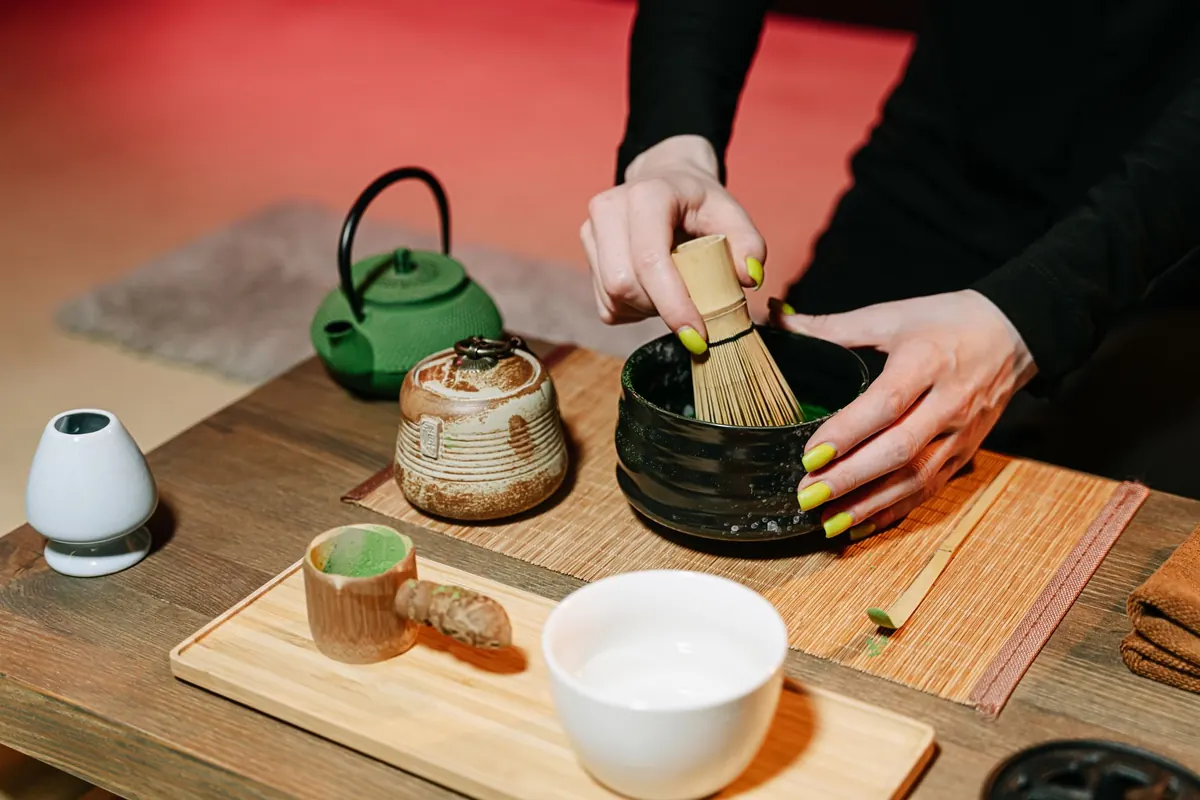
Photo: Ivan S / Pexels