
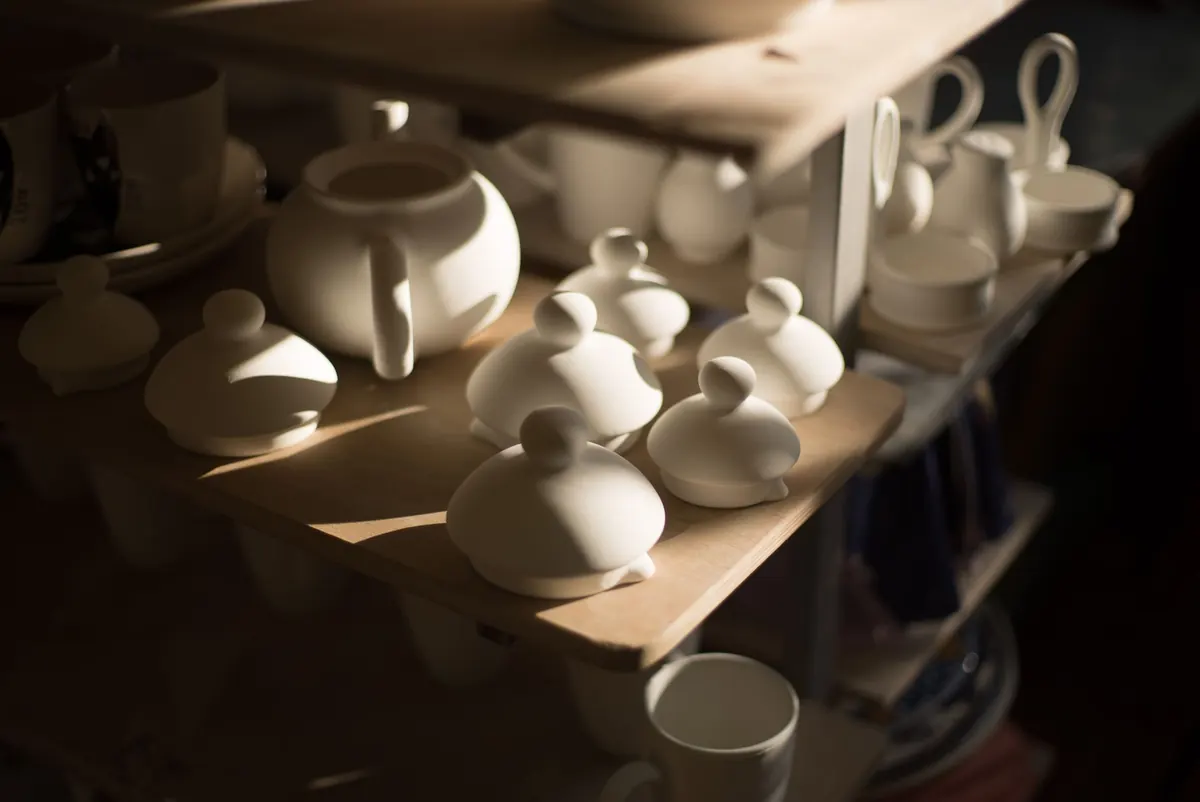
Two teapots sit side by side on a shelf. One was thrown on a wheel, trimmed by hand, and glazed from a bucket in a small studio. The other came out of a mold, identical to thousands of others, glazed by machine and fired in a tunnel kiln. From three feet away they can look almost the same. After six months of daily use, they rarely do.
None of this means handmade is automatically better. A well-run factory can produce a reliable, pleasant teapot at a price a studio potter cannot match. The trick is knowing what changes when a pot is made by hand and what stays the same, so you spend your money on purpose instead of on a label.
Consistency: Two Very Different Ideas of "The Same"
Factories win on uniformity, and that is not a small thing. Molded bodies have consistent wall thickness, lids that seat the same way every time, and spouts aligned to a specification. Break a lid and you can often order another one. Buying six teapots for a café? That predictability matters.
Handmade pots vary, not because the potter is careless, but because the process involves a human body. The wall on one side may be a millimeter thicker. The lid may settle with a slightly different feel. Two teapots from the same maker in the same month will pour a little differently.
What you get in exchange is attention in places a mold cannot reach. A potter usually tests the pour before the final firing, adjusting the spout lip and the air hole so the stream breaks cleanly. That is why two pots of similar shape can behave completely differently at the table.
A thirty-second test before you commit
- Fill the pot with water and pour slowly into a cup.
- Watch the spout lip: a good pot cuts the stream off cleanly instead of dribbling down the side.
- Tilt the pot fully and check the lid. Some movement is normal; a lid that falls out is not.
- Feel the weight when full. A pot that is awkward when heavy will end up on the shelf.
Clay Quality and What It Does to Tea
Clay is where the biggest invisible differences live. Mass-produced teapots are often slip-cast from a standardized body, sometimes with fillers added to help the mold release and the shape hold. That can work perfectly well. Problems tend to appear in cheap, low-fired earthenware: porous walls that hold onto the last tea you brewed, poor heat retention, and a tendency to crack when hit with boiling water.
A studio potter chooses clay for a specific job. Stoneware for heat retention and durability. Porcelain for a neutral flavor, since the vitrified body gives up almost nothing to the water. Unglazed, high-fired clay for the seasoned approach, the kind of pot that gradually takes on the character of the tea you brew in it. That is either the whole point or a chore, depending on your habits.
Ask about the firing, not just the clay
Firing temperature matters more than most buyers realize. High-fired stoneware and porcelain fuse into a dense, glassy body that resists staining and handles thermal shock. Low-fired earthenware stays more porous and more fragile. If a seller cannot tell you roughly how hot the pot was fired, treat that as a gap in the information and ask the maker directly when you can.
Glaze Safety: The Question Worth Asking
A glaze is essentially a thin layer of glass, and what goes into that glass matters. Lead was once common in glazes, and some imported ceramics still fail food-safety standards. Modern glazes made for dinnerware are generally formulated to be food-safe when fired correctly, but "fired correctly" is doing real work in that sentence. An underfired glaze can leach.
So ask. Good questions: Is the interior glaze food-safe and lead-free? Was the pot fired to the temperature the glaze requires? Is there any decorative glaze on the inside?
Inspect the interior in daylight. Crazing, a web of fine cracks in the glaze, is not automatically unsafe, but it creates places for tea residue to collect. Pinholes, rough patches, and unglazed rims inside the brewing chamber are worth noting. Unglazed interiors are traditional and fine for tea when the clay is properly vitrified, but they will absorb flavor over time.
When in doubt about a specific pot, don't brew in it until you have confirmed the details with the maker or a qualified ceramics professional.
Price: Where the Money Actually Goes
Handmade teapots usually cost more for unglamorous reasons. A potter shapes one pot at a time, waits for leather-hard trimming, mixes or buys small batches of glaze, loads a kiln, and fires twice: a bisque firing and a glaze firing. Studio space, electricity, and failed pots all factor in. That effort gets spread across one object instead of thousands.
Factory teapots spread the same design work and mold cost across a production run, which is why they can be cheap and still consistent. The confusion comes from the middle ground: mass-produced pots marketed as "artisan" or "hand-finished." Hand-finished can mean a worker touched the rim with a sponge, which is technically true and not very meaningful.
Repairability and the Long Life of a Pot
Here is where the two paths diverge sharply. A factory teapot is replaceable as long as the model is still in production. Once it is discontinued, a matching lid or infuser basket can be impossible to find.
A handmade pot is often repairable in ways a molded pot is not, because the clay is thick enough to work with. Options include food-safe epoxy for a chip on the outside, a ceramics restorer for a spout, or kintsugi, the Japanese practice of mending with lacquer and powdered metal, for a pot you love enough to display the repair.
The flip side: a handmade pot is usually irreplaceable. If it shatters, you may wait months for the same potter to make another, and it will not be identical.
Reading the Marks on the Base
Turn the pot over. Factory pieces usually carry a printed brand, a country of origin, and sometimes a model number. Studio pots carry a maker's mark: an impressed stamp, carved initials, a studio chop, occasionally a date. On a good handmade pot, that mark is the maker's signature and a way to trace the piece later.
A few practical uses for the mark:
- Photograph it before you buy, especially at a market where you may forget the seller's name.
- Search the mark online to learn about the potter and how they fire.
- Ask whether the maker sells replacement lids or offers repairs.
- Be skeptical when a mass-produced pot has no mark at all but a "handmade" sticker on the box.
Choosing Well, Whichever You Buy
Both kinds of teapot belong in a kitchen. A sturdy factory pot is a sensible daily brewer, easy to replace and easy to lend. A handmade pot is an object with a person behind it, and it rewards the same care you give a favorite knife or a good pan.
Match the pot to the job. For a busy household brewing the same tea every morning, consistency and replacement parts matter more than individuality. For a tea you drink slowly, or a pot you hope to hand down, the maker's choices of clay, glaze, spout, and mark are worth paying for.
Whatever you choose, buy from someone who can answer questions. A potter who tells you the clay body, the firing range, and the glaze they used is giving you more than a sales pitch. That is the information you need to brew well and keep the pot working for years.
Photo: cottonbro studio / Pexels